
Europe defense framework, Mecca Pact & Egypt in Somalia
European defense leaders and NATO have established a new autonomous framework to sustain continental security and support for Ukraine. Meanwhile, the newly operational Mecca Defense Alliance has initiated diplomatic talks in Tehran, and Egypt deployed troops to Somalia, shifting regional balances.
12 stories46 sources checked
Listen to this edition
PiBrief Geopolitics, October 27, 2026
The lineup
In this edition
 01
Europe's E5, NATO Establish Autonomous Defense Framework for Ukraine
 02
Mecca Pact Powers Meet Tehran: Coercive Diplomacy for Regional De-escalation
- 03
Egypt Deploys Brigade to Somalia, Reshaping Horn of Africa Security Landscape
 04
Moscow GECF Summit Amid U.S. Legal Clash Over Russian Diesel Imports
 05
US-Mediated Local Truce Holds in Oleshky, Ukraine for Humanitarian Aid
- 06
US Readies G20 Agenda for Supply Chains and Maritime Security in Atlanta Meeting
 07
Washington and Nuku'alofa Forge Digital and Maritime Security Pact
 08
Germany and Singapore Deepen Strategic Partnership in Tech, Trade, and Defense
 09
Poland and Vietnam Establish Strategic Partnership to Boost Trade and Defense Cooperation
- 10
Japan and Bangladesh Strengthen Indo-Pacific Ties with New Bilateral Agreement
 11
Canada and UAE Sign Landmark $70 Billion Strategic and Economic Partnership
 12
USTR Extends Suspension of China Maritime Tariffs, Preserving Trade Detente
See all 12 as a listHide the list
- Europe's E5, NATO Establish Autonomous Defense Framework for Ukraine
- Mecca Pact Powers Meet Tehran: Coercive Diplomacy for Regional De-escalation
- Egypt Deploys Brigade to Somalia, Reshaping Horn of Africa Security Landscape
- Moscow GECF Summit Amid U.S. Legal Clash Over Russian Diesel Imports
- US-Mediated Local Truce Holds in Oleshky, Ukraine for Humanitarian Aid
- US Readies G20 Agenda for Supply Chains and Maritime Security in Atlanta Meeting
- Washington and Nuku'alofa Forge Digital and Maritime Security Pact
- Germany and Singapore Deepen Strategic Partnership in Tech, Trade, and Defense
- Poland and Vietnam Establish Strategic Partnership to Boost Trade and Defense Cooperation
- Japan and Bangladesh Strengthen Indo-Pacific Ties with New Bilateral Agreement
- Canada and UAE Sign Landmark $70 Billion Strategic and Economic Partnership
- USTR Extends Suspension of China Maritime Tariffs, Preserving Trade Detente
Story 1 of 12
2 min read
Europe's E5, NATO Establish Autonomous Defense Framework for Ukraine
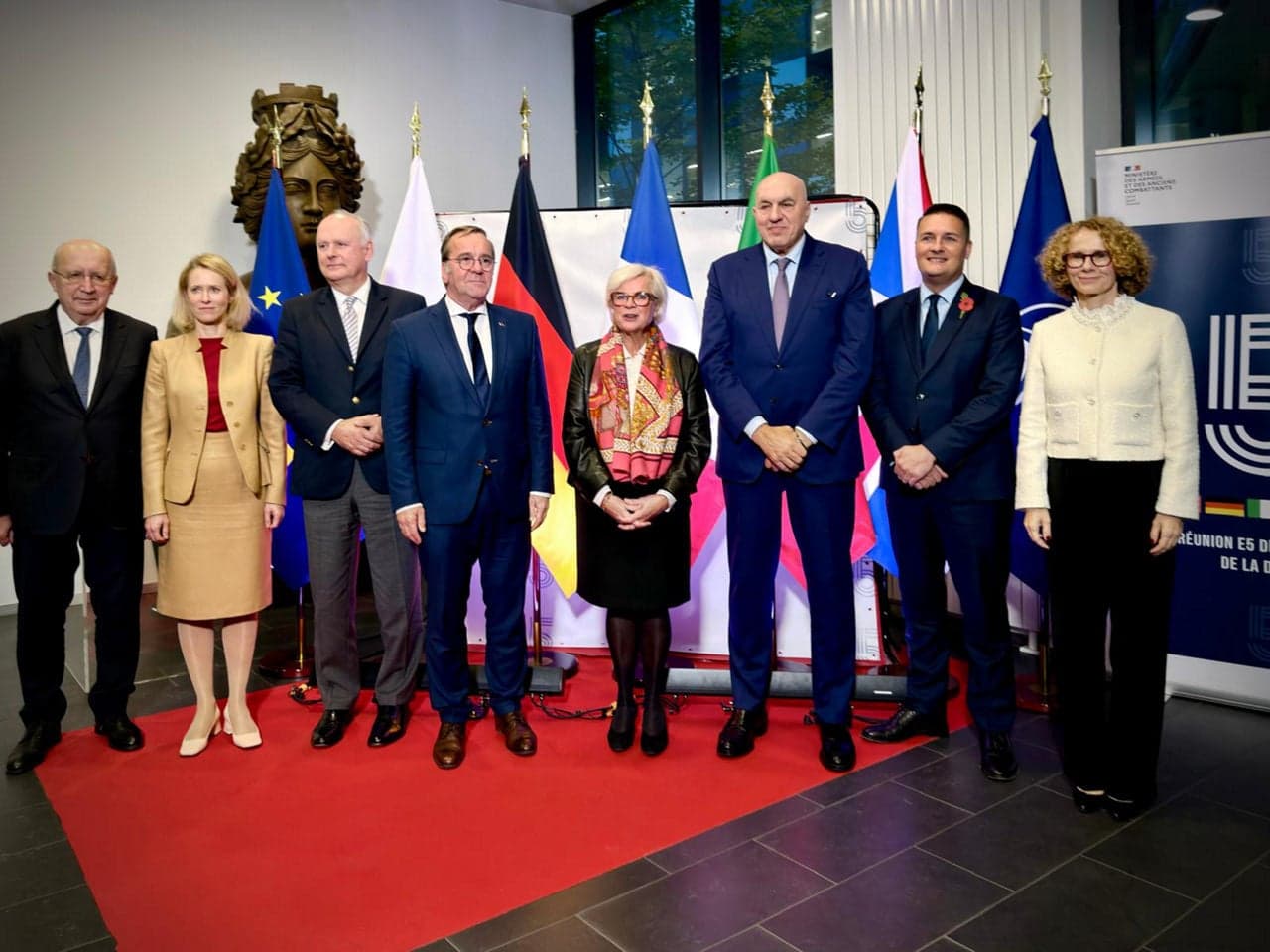
Defense ministers from France, Germany, Italy, Poland, and the UK, along with NATO and EU officials, met in Paris to institutionalize European defense production and integrate it with Ukraine's manufacturing. This policy shift aims to create an autonomous European military-industrial pipeline capable of sustaining Kyiv independently of U.S. support. The agreement focuses on long-term security and addresses the U.S. administration's reduction of aid to Ukraine.
Read the full storyFold the full story1 min · 4 sources
Defense ministers representing the European Group of Five (E5) - comprising France, Germany, Italy, Poland, and the United Kingdom - convened in Paris on October 26, 2026, alongside NATO Deputy Secretary General Radmila Shekerinska and European Union defense officials[1]. The high-level session concluded with a joint policy shift to institutionalize European-led defense production and directly integrate continental procurement lines with Ukraine’s domestic weapons manufacturing base[1]. The ministers formally affirmed that long-term continental security mandates an autonomous European military-industrial pipeline capable of sustaining Kyiv regardless of shifting political dynamics in Washington[2][1].
The conference comes amid profound structural pressure on the transatlantic alliance[3]. With the U.S. administration curtailing financial and military assistance to Ukraine and signaling an unwillingness to uphold automatic security guarantees, European capitals have been forced to accelerate strategic self-reliance[3][4]. European planners emphasized that the defense of Ukraine must no longer be treated as an ad-hoc emergency assistance program, but rather as an anchor for a revamped European collective defense system, particularly as Russian military strikes against Ukrainian urban logistics and infrastructure intensify[2][1].
Under the agreements reached in Paris, the E5 powers pledged to channel advanced air defense hardware and ammunition through NATO’s PURL initiative while co-investing in Ukrainian facilities producing long-range interceptors and autonomous strike systems[1]. In parallel, the E5 and NATO leadership reviewed maritime security commitments, issuing a joint mandate to protect vital international sea lines and ensure freedom of navigation across trade chokepoints currently destabilized by regional conflict[1].
European leaders stressed that this coordination represents a fundamental turning point from strategic ambiguity to institutionalized collective burden-sharing[3][1]. By coordinating defense industrial capabilities across the continent’s five primary military spenders, the E5 is establishing a viable European pillar within NATO designed to deter eastern aggression independently, establishing a new baseline for European security cooperation[1].
- European Group of Five (E5)
- NATO
- European Union
Story 2 of 12
2 min read
Mecca Pact Powers Meet Tehran: Coercive Diplomacy for Regional De-escalation
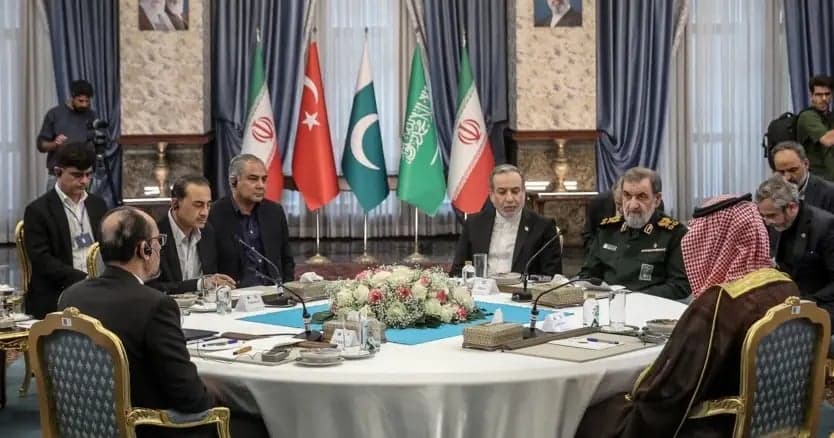
Senior security and diplomatic leaders from Saudi Arabia, Pakistan, and Turkey held unprecedented talks in Tehran with Iranian President Masoud Pezeshkian and SNSC Secretary Mohsen Rezaei. This engagement, the first collective high-level meeting since the Mecca Joint Defense Alliance's activation, aims to address regional military escalation, particularly Saudi Arabia's ongoing struggle with Iran-backed Houthi strikes. The mission employs 'coercive diplomacy,' presenting Tehran with a choice between de-escalation or facing a consolidated Sunni military counter-deployment.
Read the full storyFold the full story2 min · 9 sources
Senior security and diplomatic leadership from Saudi Arabia, Pakistan, and Turkey convened in Tehran on October 26, 2026, for unprecedented quadrilateral negotiations with the Iranian government[1]. The delegation included Saudi Defense Minister Prince Khalid bin Salman, Pakistan’s Chief of Army Staff Field Marshal Asim Munir, and Turkey’s National Intelligence Organization (MIT) Director Ibrahim Kalin, who met directly with Iranian President Masoud Pezeshkian and Supreme National Security Council (SNSC) Secretary Mohsen Rezaei[2]. The direct talks represent the first high-level collective engagement between the signatories of the tripartite Mecca Joint Defense Alliance and Tehran since the bloc's creation, coming at an inflection point of regional military escalation[1][2].
The diplomatic initiative follows the ratification and operational activation of the Mecca Joint Defense Agreement, signed in August 2026, which binds Riyadh, Islamabad, and Ankara under a mutual defense clause stipulating that a military attack on one signatory constitutes an attack on all three[1][3]. With Saudi Arabia enduring sustained, near-daily drone and ballistic missile salvos from Yemen’s Iran-backed Ansar Allah (Houthi) movement targeting critical energy installations, commercial airports, and municipal centers, the alliance reached an operational turning point[4][3]. After the three partners agreed on October 5 to prepare rapid collective military deployments to Saudi soil, Field Marshal Munir spearheaded the Tehran visit to combine visible military deterrence with urgent diplomatic de-escalation[1][3].
Regional analysts have characterized the mission as an aggressive exercise in "coercive diplomacy," presenting Tehran with a clear choice between negotiating a halt to regional proxy hostilities or facing a consolidated, multinational Sunni military counter-deployment on Iran’s immediate periphery[5]. Concurrent diplomatic reporting also pointed to transactional inducements; regional accounts revealed that Saudi negotiators attempted to broker a cessation of Houthi strikes by routing potential economic relief pledges through Tehran, testing Iran's willingness to rein in its Yemeni partners while the broader region braces for potential renewed American and Israeli military strikes against Iranian targets[2][6][4].
The Tehran summit signaled an operational evolution in regional defense alignments, demonstrating that Middle Eastern powers are actively establishing independent collective security frameworks rather than relying exclusively on traditional Western defense architecture[3][7]. Financial markets reacted with cautious relief; global benchmark Brent crude slipped approximately 1% from multi-month highs of $117 down to $114.81 per barrel as news of the talks reduced immediate fears of an imminent military confrontation around the Strait of Hormuz[8]. However, Iranian officials insisted they would maintain their strategic posture despite external threats, leaving the durability of any regional de-escalation fragile as coalition air defenses continue intercepting inbound missiles across the Gulf[6][9].
- Saudi Arabia
- Pakistan
- Turkey
Story 3 of 12
2 min read
Egypt Deploys Brigade to Somalia, Reshaping Horn of Africa Security Landscape
Egypt has deployed a brigade-sized battle group to Somalia under a bilateral defense pact with Mogadishu, establishing operational outposts and preparing for integration into the African Union Support and Stabilisation Mission in Somalia (AUSSOM). This move operationalizes a 2024 military cooperation agreement and arrives amid geopolitical tensions in the Horn of Africa, including Ethiopia's port deal with Somaliland and Egypt's dam dispute with Ethiopia.
Read the full storyFold the full story1 min · 1 source
Egypt initiated the forward deployment of a brigade-sized battle group to Somalia on October 26, 2026, activating a bilateral defense pact with Mogadishu and establishing operational military outposts prior to the force's partial integration into the African Union Support and Stabilisation Mission in Somalia (AUSSOM)[1]. Egyptian vanguard forces began preparing a tactical operational command at Ceelcade near the Ciciley airfield in the Middle Shabelle region north of the Somali capital[1]. Approximately 1,000 of these troops are slated to transition into formal AUSSOM command structures, while remaining support elements will operate under direct bilateral Egyptian authority at the specific request of Somali President Hassan Sheikh Mohamud’s government[1].
The move operationalizes the military cooperation agreement signed between Cairo and Mogadishu in August 2024, which has since seen heavy Egyptian shipments of armored combat vehicles, munitions, and defensive armaments arrive in Somalia, alongside military training delegations[1]. Cairo’s forward movement into Somalia takes place against the backdrop of an acute geopolitical standoff across the Horn of Africa, triggered by Ethiopia’s controversial maritime port memorandum with the breakaway region of Somaliland, as well as Cairo's longstanding confrontation with Addis Ababa over the Grand Ethiopian Renaissance Dam (GERD).
The deployment dramatically alters the military balance of the Horn of Africa and the perimeter of the Bab el-Mandeb strait[1]. By establishing boots on the ground in sectors historically secured by Burundian and Ethiopian forces, Egypt effectively opens an active southern flank adjacent to Ethiopia[1]. For Somalia, the bilateral arrangement provides a powerful external state backer to counter domestic insurgent threats from Al-Shabaab and check Ethiopian regional designs[1].
However, the unilateral nature of the deployment has triggered operational frictions within the African Union[1]. Regional security monitors point out that integrating bilateral battle groups into AUSSOM while the mission grapples with severe budgetary shortfalls - compounded by uncertainty surrounding United States logistical funding through the UN Support Office in Somalia (UNSOS) - risks fracturing command-and-control protocols on the front lines[1]. The maneuver firmly establishes Cairo as an indispensable security actor along the East African littoral, shifting the geopolitical balance across the continent[1].
- Egypt
- Somalia
- African Union Support and Stabilisation Mission in Somalia (AUSSOM)
Story 4 of 12
2 min read
Moscow GECF Summit Amid U.S. Legal Clash Over Russian Diesel Imports
Russian President Vladimir Putin convened the Gas Exporting Countries Forum (GECF) summit in Moscow to discuss global natural gas output and energy transit partnerships. Concurrently, U.S. Representative Jamie Raskin warned major industry groups that importing Russian diesel violates statutory prohibitions, challenging White House executive waivers used to counter rising domestic fuel prices. Lawmakers have alerted commercial entities to potential legal penalties for non-compliance.
Read the full storyFold the full story2 min · 9 sources
On October 27, 2026, Russian President Vladimir Putin convened the 8th Summit of Heads of State and Government of the Gas Exporting Countries Forum (GECF) in Moscow, leveraging the multilateral assembly to coordinate global natural gas output and expand alternative energy transit partnerships across Eurasia, the Middle East, and North Africa[1][2]. Delivering remarks during the plenary session and scheduling bilateral consultations with visiting heads of state, the Kremlin sought to project long-term control over global hydrocarbon supplies[1][2]. The summit takes place against a backdrop of tight international fuel supplies, with crude holding above $115 per barrel and refined petroleum products facing systemic refining shortfalls in Western markets[3][4].
Simultaneously in Washington, the geopolitical friction surrounding Russian fuel trade triggered a domestic and legal clash[5][6]. On October 26, Representative Jamie Raskin, Ranking Member of the House Judiciary Committee, dispatched warning notices to the chief executives of the American Petroleum Institute (API), the U.S. Chamber of Commerce, and American Fuel & Petrochemical Manufacturers (AFPM)[7][6]. Raskin warned that executive efforts to import nearly 2 million tons of Russian diesel - including an initial 300,000-ton cargo reported to be en route - directly violate statutory prohibitions codified in the Ending Importation of Russian Oil Act of 2022, which bars all Russian energy imports absent an explicit congressional waiver certifying an end to hostilities in Ukraine[7][4][8].
The dispute exposes an escalating divide between executive crisis-management and legislative sanctions architecture[7][8]. In an effort to counter a $2.70-per-gallon spike in domestic diesel prices ahead of the November midterm elections, the White House has utilized executive sanctions waivers and General Licenses to facilitate selected Russian diesel transactions[5][9]. In response, Raskin and a bipartisan coalition of lawmakers - including Senators Jeanne Shaheen, Chris Coons, Elizabeth Warren, and Thom Tillis - notified maritime port directors, financial institutions, and terminal operators that executive relief cannot override federal statutes[5][8]. The lawmakers placed commercial entities on notice that corporate participants could face up to $1 million in criminal penalties and 20 years’ imprisonment, instructing firms to preserve all transaction records for future congressional inquiry[7][8].
This collision between domestic statutory enforcement and emergency energy diplomacy underscores the limits of executive sanctions discretion[5][8]. While Moscow utilizes platforms like the GECF to solidify its position as an energy supplier to non-aligned markets, commercial maritime and energy firms in the West now face legal crosswinds[1][6][8]. Market analysts observed that commercial buyers and terminal operators are already retreating from processing waiver-backed Russian fuel cargoes, prioritizing long-term compliance with statutory bans over short-term price relief[6][8].
- Moscow
- GECF
- Russia
Story 5 of 12
2 min read
US-Mediated Local Truce Holds in Oleshky, Ukraine for Humanitarian Aid
A localized humanitarian ceasefire took effect in Oleshky, southern Ukraine, brokered by the U.S. administration to allow for the delivery of emergency aid and civilian evacuation. Confirmed by both Ukrainian and Russian officials, this combat pause represents the first practical outcome of Washington's strategy of pursuing micro-level conflict freezes. The town had been under intense siege, leading to severe civilian deprivation.
Read the full storyFold the full story1 min · 4 sources
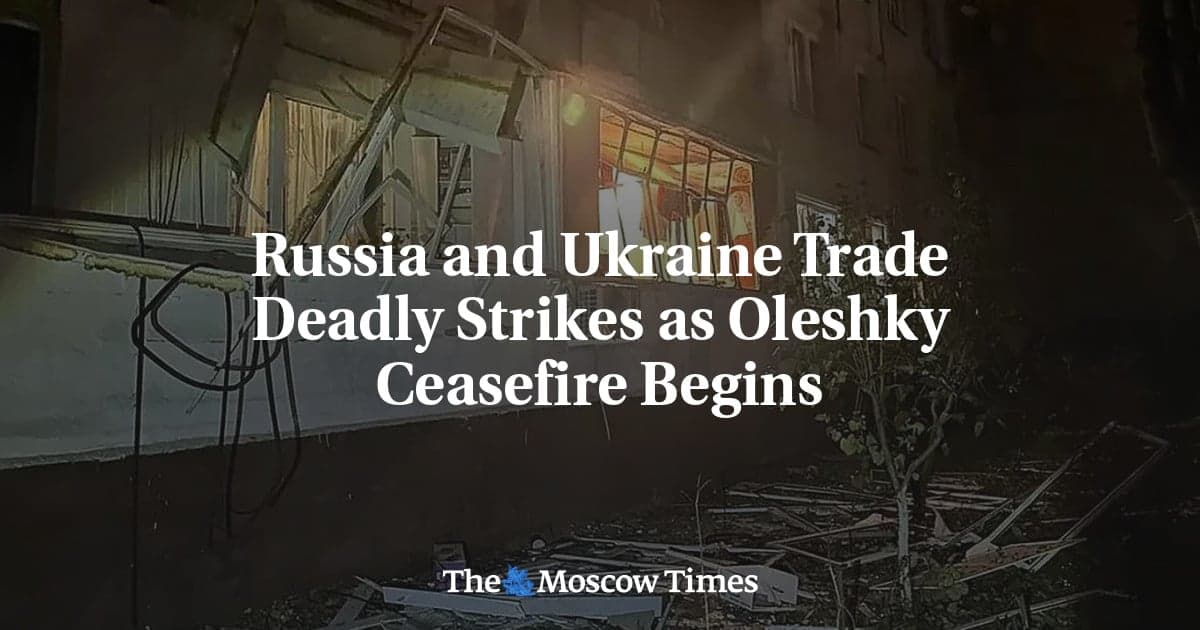
A localized humanitarian ceasefire took effect on the morning of October 27, 2026, in the frontline town of Oleshky in occupied southern Ukraine, governed by terms brokered directly through an initiative led by the U.S. administration[1]. The combat pause, designed to open humanitarian corridors for the delivery of emergency pharmaceuticals, basic foodstuffs, and the evacuation of vulnerable civilians, was simultaneously confirmed by Ukrainian and Russian officials[1]. It represents the first tangible operational outcome of Washington's shift toward localized, micro-level conflict freezes[1][2].
The agreement follows weeks of transactional mediation between U.S. envoys, Moscow, and Kyiv[1]. Oleshky had suffered weeks of intense urban bombardment and siege conditions, resulting in severe civilian deprivation and the total breakdown of civic utility networks[1]. The diplomatic intervention was advanced by U.S. President Donald Trump’s foreign policy team as a proof-of-concept model, seeking to establish hyper-localized demilitarized pauses along key sectors of the front lines rather than pursuing broad, comprehensive peace frameworks that have stalled across the international system[1][2].
Despite the local silence of heavy artillery within Oleshky, the strategic reality surrounding the enclave remains intensely volatile[1]. Long-range kinetic exchanges, Ukrainian deep-strike drone operations against Russian domestic logistics hubs, and Russian ballistic missile barrages against regional centers continued unabated across the wider theater of operations, resulting in casualties within hours of the local truce taking effect[3][1].
Diplomats and humanitarian monitors have reacted cautiously to the development[2]. While relief agencies mobilized convoys to capitalize on the corridor, European security officials expressed apprehension that localized ceasefires serve as tactical operational breathers for occupying forces rather than viable steps toward a just and lasting settlement[4][1][2]. The tactical freeze in Oleshky nonetheless illustrates an evolving American diplomatic doctrine prioritizing pragmatic, piecemeal pauses over sweeping multilateral guarantees[1][2].
- Ukraine
- United States
- Oleshky
Story 6 of 12
1 min read
US Readies G20 Agenda for Supply Chains and Maritime Security in Atlanta Meeting
The United States will host a G20 Foreign Ministers’ Meeting in Atlanta, focusing the agenda on global supply chain integrity and maritime security. Secretary of State Marco Rubio aims to lay groundwork for the Leaders’ Summit by addressing disruptions in critical shipping lanes and securing key resources.
Read the full storyFold the full story1 min · 2 sources
The United States Department of State announced that Secretary of State Marco Rubio will convene foreign ministers from the world’s leading economies in Atlanta, Georgia, for a high-stakes G20 Foreign Ministers’ Meeting[1]. The administration confirmed that the diplomatic gathering will explicitly redirect the G20’s agenda toward core economic security, critical supply chain integrity, and maritime freedom of navigation, laying the operational groundwork for the upcoming Leaders’ Summit in Miami, Florida[1].
The policy shift signals a recalibration of Washington’s engagement within multilateral forums, prioritizing actionable economic resilience over sprawling communiqués[1]. By convening the summit in Atlanta - an international logistics, transportation, and commercial hub - the State Department is emphasizing physical trade routes and infrastructure[1]. Key agenda items include mitigating acute disruptions along global maritime choke points, particularly in the Middle East and surrounding waters, which have roiled global shipping and driven crude oil benchmarks to sustained highs[2][1].
The Atlanta meeting will test the diplomatic cohesion of the G20, bringing Western nations into direct dialogue with key Global South economies and strategic competitors[1]. Secretary Rubio plans to press visiting diplomats on securing critical semiconductor minerals, agricultural supply networks, and commercial sea-lane protections against state-backed and asymmetric maritime threats[1].
This realignment of G20 priorities highlights how international economic diplomacy has become inextricably merged with defense and security interests[1]. Global markets and supply chain operators are closely tracking the upcoming Atlanta ministerial, as any consensus reached on securing navigation and critical infrastructure could determine the trajectory of international trade stability and inflationary pressures heading into the next year[2][1].
- United States
- G20
- Marco Rubio
Story 7 of 12
2 min read
Washington and Nuku'alofa Forge Digital and Maritime Security Pact
The U.S. and Tonga have finalized bilateral agreements to enhance Tonga's digital sovereignty and expand Pacific maritime surveillance capabilities. The pact includes U.S. funding for modernizing Tonga's data centers, implementing cloud-migration protocols, and constructing secure subsea cable connections. It also bolsters maritime enforcement against illegal fishing and establishes frameworks for assessing deep-seabed mineral resources.
Read the full storyFold the full story1 min · 8 sources
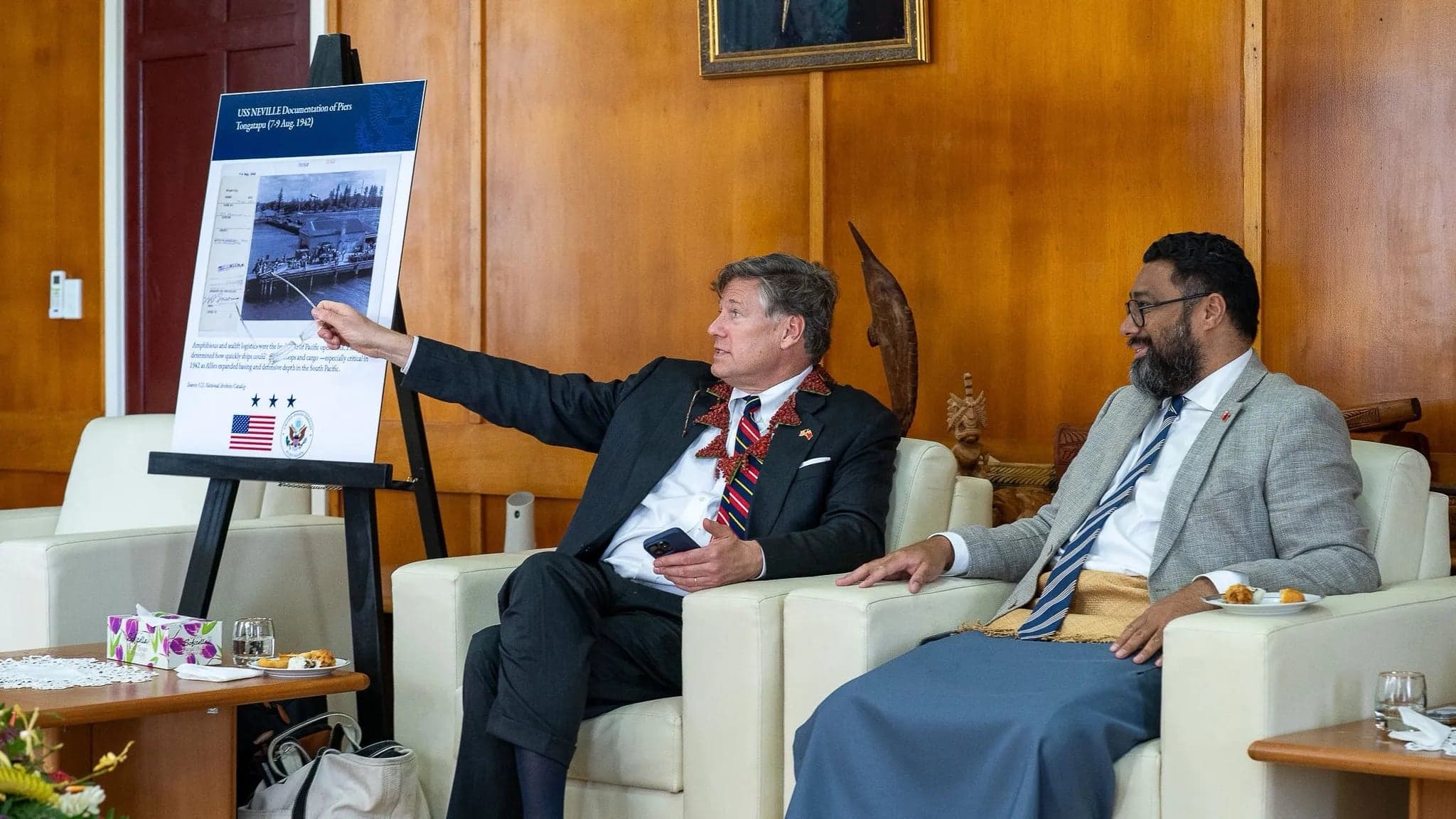
U.S. Deputy Secretary of State Christopher Landau met behind closed doors with Tongan Prime Minister Lord Fakafanua at the Department of State on October 27, 2026, finalizing bilateral agreements aimed at securing Tonga’s digital sovereignty and expanding Pacific maritime surveillance[1][1][2]. The Washington summit builds directly on momentum established during recent Pacific Islands Forum engagements, serving as a formal reset in bilateral ties following diplomatic frictions earlier this year surrounding U.S. visa-bond restrictions on Tongan nationals[3][4][5].
At the center of the engagement is a series of digital infrastructure and critical systems initiatives financed through the U.S. Trade and Development Agency (USTDA) and technical partners, including cybersecurity provider CyberCX USA[6]. The bilateral program establishes an initiative to modernize Tonga’s whole-of-government data centers, implement advanced cloud-migration protocols, and construct disaster-resilient communications backbones[3][6]. Crucially, the pact includes a $6 million U.S. commitment to construct dedicated subsea cable branching units connecting Tonga into the Pacific Connect network, providing the island nation with redundant, secure data links[2].
The digital partnership is paired with expanded defense and maritime operations[2]. Under agreements reaffirmed during the meeting, the U.S. Coast Guard and Tongan authorities are operationalizing maritime enforcement protocols to combat illegal, unreported, and unregulated (IUU) fishing in Tongan waters, supported by U.S.-financed Automatic Identification Systems (AIS) and surveillance architecture[2]. The bilateral collaboration also establishes initial frameworks for marine scientific research to assess deep-seabed mineral resources within Tonga’s exclusive economic zone (EEZ), an emerging frontier of strategic resource competition[2].
The Landau-Fakafanua discussions demonstrate how micro-state diplomacy has become central to Indo-Pacific strategic competition[7][6][8]. Facing sustained Chinese diplomatic and commercial inroads across Polynesia and Melanesia - where Beijing has aggressively sought port, security, and telecommunications contracts - Washington is focusing its engagement on digital infrastructure, undersea telecommunications, and maritime security[7][6][2]. By providing modern data architecture and secure subsea connections, the United States aims to anchor Pacific Island nations within secure, Western-aligned digital and security frameworks[3][6][8].
- United States
- Nuku'alofa
- Tonga
Story 8 of 12
1 min read
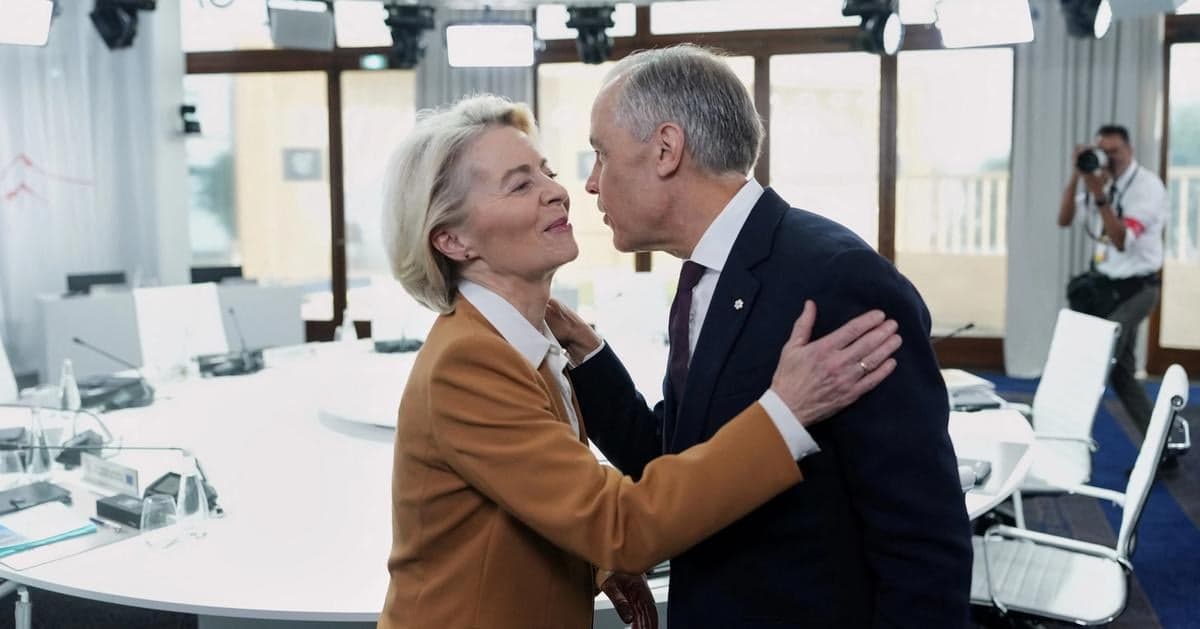
Germany and Singapore Deepen Strategic Partnership in Tech, Trade, and Defense
German Chancellor Friedrich Merz visited Singapore, meeting Prime Minister Lawrence Wong to operationalize their Strategic Partnership. The agreement focuses on deepening cooperation in advanced technologies, cybersecurity, defense innovation, and critical supply chain resilience, reflecting Germany's de-risking strategy in East Asia.
Read the full storyFold the full story1 min · 2 sources
German Chancellor Friedrich Merz concluded his first official bilateral visit to Singapore, holding high-level talks and a joint press appearance with Singaporean Prime Minister Lawrence Wong[1]. The summit between the two heads of government marked a significant step in operationalizing the Germany-Singapore Strategic Partnership, established to deepen cooperation across advanced technologies, trade, cybersecurity, defense innovation, and critical supply chain resilience[1].
The diplomatic encounter in Singapore reflects Germany’s broader foreign policy doctrine under Chancellor Merz, aimed at de-risking its economic footprint in East Asia while actively diversifying trade partnerships across the Indo-Pacific[1]. For Berlin, Singapore represents an indispensable logistics, financial, and technological node in Southeast Asia[1]. For the city-state, Germany provides crucial high-end industrial expertise, access to European green technology, and enhanced naval and defense interoperability[1].
During the joint address, both leaders underlined the absolute necessity of maintaining an open, rules-based international maritime and trading order, warning of the compounded economic shocks created by heightened protectionism and regional military flashpoints[2][1]. Prime Minister Lawrence Wong stressed that open trade corridors remain existential for small, trade-dependent nations, while Chancellor Merz reiterated Germany’s intent to maintain regular naval deployments and strategic engagement across the Indo-Pacific theatre[1].
The deepened cooperation signals to multinational corporations and technology investors that European and Southeast Asian powers are aggressively building redundant industrial networks[1]. Bilateral agreements touched upon joint research into artificial intelligence governance, green maritime corridors, and enhanced semiconductor logistics, reflecting how traditional bilateral diplomacy is being retooled to insulate national economies against external trade coercion and supply disruption[1].
- Germany
- Singapore
- Friedrich Merz
Story 9 of 12
1 min read
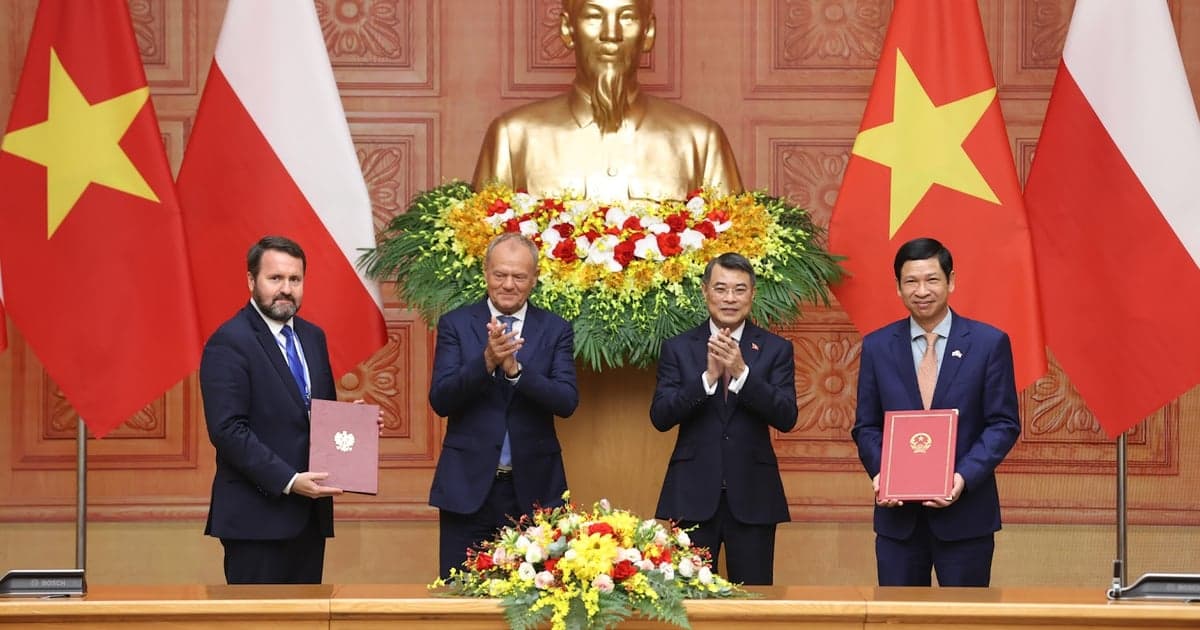
Poland and Vietnam Establish Strategic Partnership to Boost Trade and Defense Cooperation
Polish Prime Minister Donald Tusk and Vietnamese Prime Minister Le Minh Hung signed an agreement elevating their bilateral relationship to a Strategic Partnership. This accord will enhance cooperation in political dialogue, national defense, economic security, and technology exchange, building on significant growth in bilateral trade.
Read the full storyFold the full story1 min · 1 source
Polish Prime Minister Donald Tusk concluded an official state visit to Hanoi, where he and Vietnamese Prime Minister Le Minh Hung formally signed an agreement elevating the two countries' relationship to a "Strategic Partnership"[1]. Marking over 76 years of diplomatic relations, the accord establishes a new framework for bilateral cooperation covering political dialogue, national defense, economic security, and technology exchange[1].
The elevation of ties highlights Vietnam’s highly pragmatic "bamboo diplomacy," which seeks to balance and diversify international partnerships across multiple continents without binding itself into formal military alliances. Concurrently, it represents Central and Eastern Europe’s expanding diplomatic footprint in Southeast Asia. Poland has emerged as one of Vietnam’s fastest-growing trading partners within the European Union, with two-way bilateral trade climbing nearly 15 percent year-on-year to approach $4 billion[1].
Under the signed declaration, the two governments agreed to formally resume the long-dormant Inter-governmental Committee on Economic Cooperation and establish regular deputy-foreign-minister-level political consultations[1]. Discussions between Prime Minister Tusk and Prime Minister Le focused on facilitating market access for Polish agri-food products, electronics, and pharmaceuticals, while simultaneously securing Vietnamese manufacturing components and minerals critical to Central European industrial supply chains[1].
The agreement underscores how mid-sized powers in Europe and the Global South are bypassing standard regional blocs to forge direct, high-value bilateral partnerships[1]. By securing a Strategic Partnership with Poland, Vietnam deepens its institutional access into the European Union's manufacturing core, while Warsaw establishes an economic anchor within the Association of Southeast Asian Nations (ASEAN)[1].
- Poland
- Vietnam
- Donald Tusk
Story 10 of 12
2 min read
Japan and Bangladesh Strengthen Indo-Pacific Ties with New Bilateral Agreement
Japanese Prime Minister Sanae Takaichi and Bangladeshi Prime Minister Tarique Rahman met in Tokyo, reaffirming Japan's commitment to Bangladesh as a key maritime partner within its Indo-Pacific vision. The leaders discussed infrastructure investments, supply chain connectivity, and expanding security cooperation in the Bay of Bengal.
Read the full storyFold the full story1 min · 1 source
Japanese Prime Minister Sanae Takaichi hosted newly inaugurated Bangladeshi Prime Minister Tarique Rahman in Tokyo for an official summit meeting, culminating in the issuance of a substantive Japan-Bangladesh Joint Statement[1]. The meeting reaffirmed Tokyo’s commitment to expanding its Strategic Partnership with Dhaka, situating Bangladesh as a pivotal maritime partner within Japan’s updated Free and Open Indo-Pacific (FOIP) vision[1].
The transition of leadership in Dhaka has catalyzed a renewed diplomatic push to stabilize Bangladesh's economic foundation and assert its foreign policy autonomy[1]. Prime Minister Takaichi explicitly highlighted Japan’s support for Bangladesh’s domestic resilience and freedom of sovereign decision-making amid intensifying geopolitical competition across the Bay of Bengal[1]. Prime Minister Rahman reciprocated by recognizing Japan's historic role as one of the first nations to extend diplomatic recognition following Bangladesh’s independence, describing Tokyo as an indispensable partner for modern development[1].
The discussions centered on tangible infrastructure investments, supply chain connectivity, and trade cooperation[1]. Central to Tokyo's engagement is the development of deep-sea port facilities, transport corridors, and industrial parks designed to link landlocked northeastern India and Bangladesh to maritime shipping lanes[1]. The joint statement laid out accelerated pathways toward finalizing an Economic Partnership Agreement (EPA) and expanding security cooperation to protect freedom of navigation in the northern Indian Ocean[1].
For South Asia’s geopolitical architecture, the reinforced Tokyo-Dhaka alliance provides Bangladesh with an alternative source of capital, infrastructure development, and technical expertise without becoming over-reliant on any single superpower[1]. For Japan, expanding ties with Dhaka ensures that vital maritime energy corridors traversing the Bay of Bengal remain open, stable, and protected under international legal norms[1].
- Japan
- Bangladesh
- Sanae Takaichi
Story 11 of 12
2 min read
Canada and UAE Sign Landmark $70 Billion Strategic and Economic Partnership
Canadian Prime Minister Mark Carney and Abu Dhabi Crown Prince Sheikh Khaled bin Mohamed bin Zayed Al Nahyan finalized a comprehensive bilateral strategic partnership and economic agreement in Ottawa. The pact includes a $70 billion UAE investment commitment targeting Canadian ventures and establishes a significant economic and defense-technology corridor between the two nations. The agreement was concluded rapidly, in just 47 days of formal diplomacy.
Read the full storyFold the full story1 min · 5 sources
Canadian Prime Minister Mark Carney welcomed the Crown Prince of Abu Dhabi, Sheikh Khaled bin Mohamed bin Zayed Al Nahyan, to Ottawa on October 26 and 27, 2026, to formally execute a comprehensive bilateral strategic partnership and celebrate the completion of the Canada-UAE Comprehensive Economic Partnership Agreement (CEPA)[1][2][3]. Concluded in a record 47 days of formal diplomacy, the pact secures a massive economic and defense-technology corridor connecting Ottawa and the Gulf monarchy, backed by an overarching $70 billion UAE investment commitment targeting Canadian sovereign ventures[2].
The bilateral agreement reflects a deliberate foreign policy pivot by the Carney administration to rapidly diversify Canada's trade architecture, foreign direct investment, and critical resource corridors amid severe tariff disputes and trade instability with the United States[2][4]. The Abu Dhabi delegation included key Emirati cabinet officials - such as Minister of Industry and Advanced Technology Sultan Ahmed Al Jaber, Minister of Foreign Trade Thani Al Zeyoudi, and Minister of Investment Mohamed Hassan Al Suwaidi - reflecting a whole-of-government mobilization aimed at integrating Gulf sovereign wealth directly into Canadian supply chains[5].
Beyond mutual tariff reductions on manufactured goods and agricultural products, the strategic partnership establishes formal mechanisms for joint defense and national security collaboration[3]. The bilateral treaty covers extensive investments in critical minerals extraction and refining, next-generation energy infrastructure, aerospace platforms, telecommunications, quantum computing systems, and defense-applicable artificial intelligence[3]. During a state dinner on Parliament Hill, Carney emphasized that the pact binds both nations in a shared imperative to "build for the future" by establishing resilient commercial networks outside traditional trading orbits[2].
The strategic deal repositions Ottawa on the international stage, shifting Canadian statecraft from defensive trade renegotiations into assertive geoeconomic alignment with key non-Western capital centers[4][3]. Business organizations in both nations applauded the regulatory certainty created by the treaty, while foreign policy observers noted that the speed and scope of the agreement underscore how mid-tier Western economies are building hedge architectures with Middle Eastern powers to insulate themselves from great-power volatility[2][4].
- Canada
- United Arab Emirates (UAE)
- Ottawa
Story 12 of 12
2 min read
USTR Extends Suspension of China Maritime Tariffs, Preserving Trade Detente
The U.S. Trade Representative's Office has proposed extending the suspension of Section 301 tariffs on China's maritime, logistics, and shipbuilding sectors until January 9, 2027. This measure temporarily freezes port entry fees and equipment levies, which were set to resume soon and could have significantly increased shipping costs. The extension provides more time for bilateral negotiations on commercial maritime competition.
Read the full storyFold the full story2 min · 5 sources
The Office of the United States Trade Representative (USTR) formally initiated a regulatory action on October 26, 2026, proposing to extend the suspension of punitive Section 301 tariffs and fees targeting China’s maritime, logistics, and shipbuilding sectors through January 9, 2027[1][2][3]. Published in the Federal Register under docket number USTR-2026-0694 with an accelerated public comment deadline of October 30, the measure temporarily freezes a complex regime of port entry fees and equipment levies that were originally scheduled to snap back into full effect at midnight on November 9, 2026[1][3]. The prospective duties had threatened to impose assessments of up to $18 per net ton or $120 per container on vessels owned or operated by Chinese entities, as well as Chinese-built ships docking at U.S. ports[2][4].
The suspension traces back to an initial Section 301 investigation initiated in 2024 into Beijing’s state-backed dominance across global logistics and commercial shipbuilding[1]. Although the U.S. government determined that China's industrial policies unfairly burdened American commerce, Washington agreed to a temporary one-year freeze following high-level bilateral economic negotiations in late 2025[1]. The two-month reprieve formalizes understandings reached during bilateral engagements between President Donald Trump and President Xi Jinping, granting trade negotiators additional runway to negotiate structural commitments regarding commercial maritime competition without disrupting cross-border trade flows[3][4].
The policy adjustment brings relief to international ocean carriers, logistics integrators, and U.S. port authorities, which had faced the risk of severe supply-chain friction heading into the winter shipping peak[2][3]. Beyond per-vessel docking fees, the reprieve freezes a 100 percent tariff on Chinese-manufactured ship-to-shore (STS) gantry cranes and additional punitive duties on intermodal chassis and components[5][4]. Shippers and trade associations had warned USTR Jamieson Greer that abruptly reimposing the fees would inflate freight rates, trigger reciprocal port retaliation in East Asia, and exacerbate congestion at major terminals like Long Beach and Los Angeles[2][4].
Despite the temporary freeze on maritime logistics, the policy does not signal a broad retreat from commercial confrontation. Concurrently on October 26, U.S. economic security agencies finalized alerts placing biotechnology on federal outbound investment screening watchlists, aligning it with existing curbs on advanced semiconductors, quantum computing, and artificial intelligence[1]. Trade law specialists noted that Washington's two-month maritime extension represents tactical containment rather than true de-escalation: the administration is deferring disruptive shipping penalties to maintain short-term maritime price stability while systematically tightening the technological and capital ring around Beijing’s strategic industries[1][3].
- Office of the United States Trade Representative
- China
- USTR
You're all caught up.
That's every story in Tuesday's PiBrief Geopolitics. And there's a newer edition waiting for you.
All PiBrief Geopolitics editions
Subscribe to receive daily briefings about geopolitics and world news in your email.
Get PiBrief Geopolitics in your inbox
A free newsletter on geopolitics and world news. Diplomacy, conflict, the global economy, and elections, ranked and explained, with an audio briefing in every edition.
Free forever / no account / 1-click unsubscribe