
NATO orbital weapon warning, COP31 collapse & Houthi strikes
NATO issues warnings regarding Russian orbital weapon capabilities while the COP31 climate summit collapses in Antalya. Meanwhile, escalating regional tensions see Houthi drone strikes target Saudi energy and defense assets.
9 stories39 sources checked
Listen to this edition
PiBrief Geopolitics, November 23, 2026
The lineup
In this edition
- 01
NATO Intelligence Warns Russia Nearing Deployment of Orbital Nuclear Weapon
 02
Ukraine Destroys Advanced Russian Warship in Mediterranean Drone Raid
 03
NATO Convenes Emergency Council as Regional Security Threats Escalate
 04
COP31 Climate Summit Collapses in Antalya Amid Unprecedented Diplomatic Breakdown
 05
Global Backlash Follows Trilateral Shenzhen Summit and Peace Declaration
 06
Dutch Foreign Minister Conducts Dual-Track Tech Diplomacy in India and China
 07
South Korea Overhauls Security Leadership to Restore Intelligence Ties with U.S.
- 08
Tajikistan Formally Withdraws from ICC, Further Eroding Global Legal Frameworks
 09
Houthi Drone Strikes Hit Saudi Energy and Defense Assets
See all 9 as a listHide the list
- NATO Intelligence Warns Russia Nearing Deployment of Orbital Nuclear Weapon
- Ukraine Destroys Advanced Russian Warship in Mediterranean Drone Raid
- NATO Convenes Emergency Council as Regional Security Threats Escalate
- COP31 Climate Summit Collapses in Antalya Amid Unprecedented Diplomatic Breakdown
- Global Backlash Follows Trilateral Shenzhen Summit and Peace Declaration
- Dutch Foreign Minister Conducts Dual-Track Tech Diplomacy in India and China
- South Korea Overhauls Security Leadership to Restore Intelligence Ties with U.S.
- Tajikistan Formally Withdraws from ICC, Further Eroding Global Legal Frameworks
- Houthi Drone Strikes Hit Saudi Energy and Defense Assets
Story 1 of 9
2 min read
NATO Intelligence Warns Russia Nearing Deployment of Orbital Nuclear Weapon
Western intelligence, including reports from Germany, indicates that Russia is preparing to launch a nuclear-armed satellite known as Sputnik-S. Designed for low-Earth orbit, the weapon is intended to trigger an electromagnetic pulse capable of devastating satellite constellations. This development threatens both commercial networks like Starlink and military intelligence infrastructure, sparking fears of a new arms race in space.
Read the full storyFold the full story1 min · 2 sources
Western intelligence agencies and NATO defense officials issued an urgent assessment that the Russian Federation is actively preparing to deploy an orbital, nuclear-armed satellite designed to target satellite networks[1]. According to intelligence findings from NATO partners, including Germany's Federal Intelligence Service (BND), the orbital weapon - designated "Sputnik-S" - was developed and completed near Moscow and is now positioned for potential launch into space[1]. The weapon is believed to be engineered to detonate a nuclear payload in low-Earth orbit, creating a high-altitude electromagnetic pulse (EMP) capable of crippling vast constellations of commercial and military satellites[1].
The revelation marks a dangerous intensification of tensions in the space domain, heightening concerns that have simmered since early allegations of Russian counterspace nuclear programs emerged in 2024[1]. Commercial proliferated satellite systems, such as SpaceX’s Starlink, have proved decisive in providing resilient battlefield communications, intelligence, and targeting capabilities for Ukraine and Western allies[1]. Western military analysts assess that Moscow views indiscriminate orbital anti-satellite weapons as an asymmetrical countermeasure to neutralize NATO’s overwhelming technological advantage in low-Earth orbit reconnaissance and data transmission[1].
The intelligence warning surfaced just as Western powers moved to accelerate their own military space architecture[2]. On November 22, the U.S. National Reconnaissance Office (NRO), in coordination with the U.S. Space Force and SpaceX, successfully launched the NROL-136 mission aboard a Falcon 9 from Vandenberg Space Force Base, marking its fourth launch of the year to deploy the largest proliferated intelligence satellite network in U.S. history[2]. Defense analysts warn that any deployment of the "Sputnik-S" would dismantle the 1967 Outer Space Treaty, trigger severe international sanctions, and fundamentally reshape the security calculus of spacefaring nations by threatening global telecommunications, navigation, and dual-use space infrastructure[1].
- NATO
- Russia
- Sputnik-S
Story 2 of 9
2 min read
Ukraine Destroys Advanced Russian Warship in Mediterranean Drone Raid
Ukrainian forces executed a high-stakes strike in the Libyan port of Benghazi, sinking the advanced Russian corvette Merkury and damaging a key logistics vessel. The operation involved seven domestic naval drones launched from a maritime mothership, marking a major geographic escalation in the conflict. The strike also destroyed an onboard helicopter and highlights Ukraine's growing capability to threaten Russian military infrastructure far from the primary front lines.
Read the full storyFold the full story2 min · 8 sources
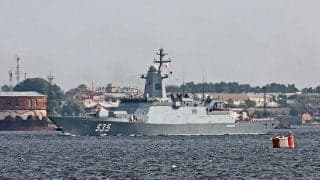
Ukrainian naval forces carried out an unprecedented long-range strike inside the Libyan port of Benghazi, sinking the Russian Navy’s advanced Steregushchiy-class missile corvette Merkury and striking a sanctioned Russian logistics vessel[1][2][3]. The operation, conducted by the Security Service of Ukraine (SBU) alongside Ukraine’s Defense Forces, utilized seven domestically manufactured naval drones launched from a maritime mothership operating in the Mediterranean Sea[4][2]. In addition to destroying the Merkury - a high-tech warship commissioned into the Russian Navy in 2023 - the strike destroyed an onboard Ka-27 combat helicopter and scored direct hits on the Russian dry-cargo vessel MV Angara, which Western intelligence and Ukrainian authorities identify as a primary vessel for ferrying weapons between Syria, Libya, and Russia[1][2]. Satellite imagery captured by commercial operators confirmed that the corvette caught fire and capsized at its berth[2][3].
The strike marks an extraordinary geographic escalation in the maritime domain of the Russia-Ukraine war, targeting Russian logistics networks more than 2,400 kilometers (1,500 miles) away from the front line[5]. Eastern Libyan authorities aligned with General Khalifa Haftar have long permitted the Russian military and maritime fleet access to eastern Libyan ports for refueling and strategic replenishment under bilateral cooperation arrangements[6][7]. By striking Merkury and Angara inside Benghazi harbor, Ukraine demonstrated an ability to hold Russian expeditionary naval assets and military logistics hubs at risk across the Mediterranean basin, coming just a day after a similar drone attack caused a fire aboard the Russian defense-linked cargo vessel Sparta II in the Gulf of Finland[8][3].
The operation has triggered immediate diplomatic and legal repercussions across North Africa and the United Nations[4]. The United Nations Support Mission in Libya (UNSMIL) expressed serious alarm, stating that Libya must not be turned into an arena for foreign conflicts and demanding an independent investigation[4]. In Tripoli, the rival UN-recognized Government of National Unity warned against the dangers of utilizing civilian and sovereign port infrastructure for external military campaigns[4]. Meanwhile, Ukrainian President Volodymyr Zelenskyy heralded the raid as an "exemplary Ukrainian operation," framing it as proof of Ukraine's indigenous naval drone advancements and a direct warning that Russian power-projection infrastructure is nowhere out of reach[1][4].
- Ukraine
- Russia
- Security Service of Ukraine
Story 3 of 9
2 min read
NATO Convenes Emergency Council as Regional Security Threats Escalate
The North Atlantic Council held emergency talks following a series of Russian border violations, including cruise missile strikes in Poland and attacks near Romanian maritime territory. These incidents occurred alongside suspected hybrid warfare operations across Scandinavia. NATO is currently struggling with internal institutional uncertainty and shifting defense commitments.
Read the full storyFold the full story1 min · 8 sources
Ambassadors to the North Atlantic Council met in Brussels on Monday, November 23, 2026, to conduct urgent threat consultations following a series of military escalations on the alliance's eastern and maritime periphery[1]. The extraordinary session was prompted by Russian cruise missiles breaching airspace and striking in southeastern Poland during broad bombardments of western Ukraine, combined with the activation of air defense systems in Russia's Kaliningrad exclave along the Lithuanian border and attacks damaging commercial shipping vessels near Romanian territorial waters in the Black Sea[2][3][1][4]. The incidents coincided with European security agencies uncovering suspected Russian-linked hybrid plots in Scandinavia, bringing allied territory uncomfortably close to kinetic conflict[1].
The crisis arrives at a precarious juncture for the Atlantic alliance, which is grappling with deep institutional uncertainty[5]. NATO planners recently moved to scale back the cadence of senior-level engagements, including shelving plans for a full leaders' summit in 2027 to avoid political friction and potential fracturing under the Trump administration[5]. European diplomats have privately voiced alarm over erratic US high-level engagement, pointing to previous defense ministerial gatherings where Pentagon leadership curtailed participation[5]. At the same time, regional defense initiatives - such as the Danish Parliament's unanimous 109–0 ratification of expanded US military basing rights in Greenland - illustrate a bifurcated reality where bilateral Arctic and bilateral defense compacts advance even as multilateral NATO cohesion frays[3].
Speaking in Canberra at the Australian Institute of International Affairs (AIIA) National Conference on November 23, David McAllister, Chair of the European Parliament’s Foreign Affairs Committee, warned that the Euro-Atlantic space has shifted from a state of "poly-crisis to an omni-crisis" where hybrid warfare, shadow-fleet maritime operations, and direct border violations intersect[6]. McAllister urged democratic allies across the Indo-Pacific and Europe to pool deterrence capabilities, warning that traditional alliance structures are being systematically probed for fractures[6]. Concurrently, European defense voices, including incoming NATO Deputy Secretary General Radmila Shekerinska, stressed that the alliance faces a critical test of will, insisting that member states rapidly accelerate indigenous European conventional defense investments rather than depending solely on Washington's deterrent umbrella[7][8].
- NATO
- North Atlantic Council
- Poland
Story 4 of 9
2 min read
COP31 Climate Summit Collapses in Antalya Amid Unprecedented Diplomatic Breakdown
The 31st United Nations Climate Change Conference in Türkiye concluded in total failure after negotiations collapsed without a final declaration. European delegates staged a walkout following the removal of fossil fuel phase-out commitments from the draft text. The impasse marks the most significant diplomatic setback for climate policy since 2009.
Read the full storyFold the full story2 min · 4 sources
The 31st United Nations Climate Change Conference (COP31) in Antalya, Türkiye, collapsed into unprecedented acrimony on Sunday, November 22, 2026, concluding without an overarching political declaration after negotiations stretched more than two days into overtime[1][2]. The breakdown marks the first total diplomatic failure to reach a negotiated final text at a UN climate summit since the Copenhagen summit in 2009[1][2]. European Union delegates, coordinated by Irish Minister for Climate Darragh O’Brien and EU Commissioner for Climate Action Wopke Hoekstra, staged an extraordinary walkout after the summit presidency circulated a draft communique that removed all concrete commitments to phase out or transition away from fossil fuels[1][3]. They were joined in opposition by the United Kingdom, Panama, Belize, and vulnerable Pacific island nations, including Tuvalu and the Marshall Islands[2][3].
The immediate catalyst for the impasse was an irreconcilable rift between climate-vulnerable economies and major fossil fuel producers led by Saudi Arabia and Russia[1][2]. While European and Pacific negotiators demanded legally anchored language tracking the transition away from hydrocarbons first agreed to at COP28 in Dubai, petro-states fiercely resisted binding phase-down timelines, demanding instead that any text emphasize carbon capture and storage (CCS) and carbon dioxide removal technologies[1]. Simmering grievances over climate finance further crippled the talks: developing nations sharply criticized the lack of actionable, non-debt adaptation capital provided by wealthier states, leaving the multilateral negotiating apparatus completely fractured[2].
The systemic fallout of the Antalya failure extends well beyond environmental diplomacy, signaling a deep fracturing of international institutional consensus[2]. In a formal reaction, UN Secretary-General António Guterres warned that the collapse does not alter planetary realities, emphasizing that the 1.5°C global warming threshold is now poised to be formally breached with diminishing hope of a short, reversible overshoot[2][3]. Commodity markets immediately felt the tremor; Brent crude fell 0.51% to $92.10 a barrel in early trading on November 23 as market analysts factored in the total absence of near-term regulatory limits on hydrocarbon exploitation, despite ongoing Middle Eastern logistical instability and attacks on regional refineries[4]. The failure underscores a growing retreat from global collective action into transactional regional blocs, leaving European policymakers isolated in their decarbonization agenda while hydrocarbon superpowers consolidate alternative trading spheres[1][2].
- COP31
- United Nations
- European Union
Story 5 of 9
2 min read
Global Backlash Follows Trilateral Shenzhen Summit and Peace Declaration
A meeting between U.S., Chinese, and Russian leaders at Kylin Villa has sparked significant criticism for its perceived endorsement of authoritarian realpolitik. The resulting Shenzhen Declaration touched on major global issues but notably omitted mentions of the ongoing wars in Ukraine and Iran. Critics and allied nations fear the summit prioritizes direct bargaining between great powers at the expense of established international legal norms and alliances.
Read the full storyFold the full story1 min · 4 sources
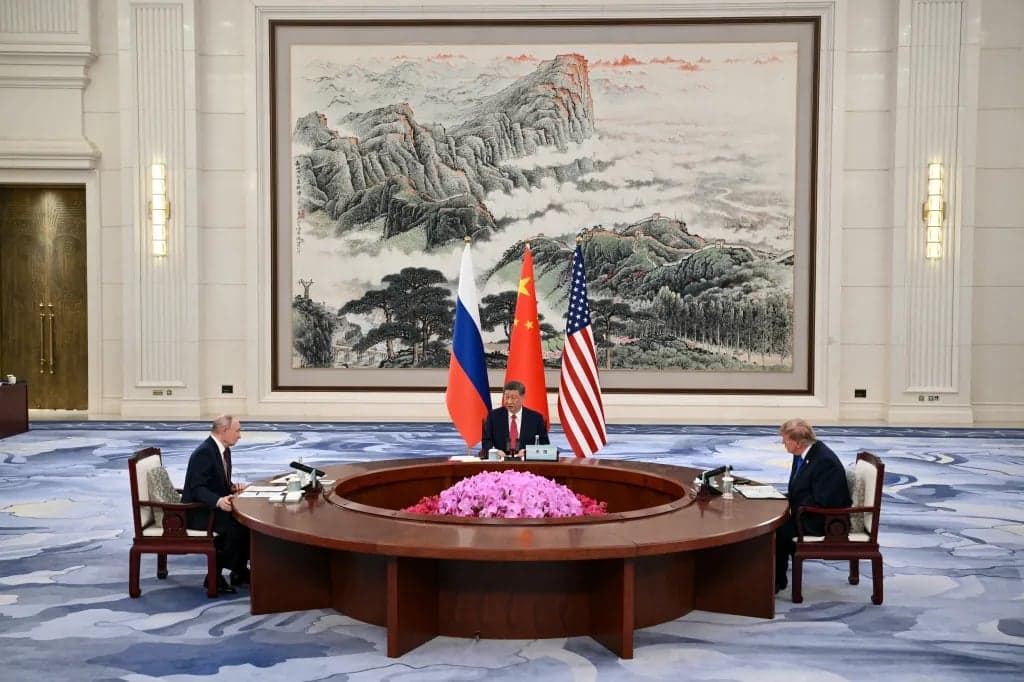
Strategic debates and political backlash intensified across global capitals in response to the summit held at Kylin Villa in Shenzhen between U.S. President Donald Trump, Chinese President Xi Jinping, and Russian President Vladimir Putin[1][2]. Following the leaders' adoption of the "Shenzhen Declaration toward Peace" - a document touching on United Nations reform, energy supply stability, nuclear risk mitigation, and international legal jurisdiction - allied governments and domestic critics scrutinized the fundamental realignments implied by the meeting[3][2].
The trilateral summit drew sharp political criticism in Washington[3]. U.S. Senate Democratic Leader Chuck Schumer denounced the encounter as a "historic embarrassment," arguing that the White House had offered diplomatic legitimacy to Beijing and Moscow without securing binding commitments on arms control, trade, or technology[3]. Prominent conservative lawmakers, including Republican Senator Rick Scott, likewise voiced alarm over the administration’s transactional posture toward authoritarian rivals[1]. Geopolitical analysts pointed out a glaring contradiction in the Shenzhen Declaration: despite framing itself as a landmark framework for international peace, the document entirely omitted the wars in Ukraine and Iran, while governments simultaneously advance unprecedented military budgets, including a proposed $1.5 trillion U.S. defense package[2].
Allied governments in Europe and the Indo-Pacific expressed deep concern over the broader systemic implications of the talks[4][2]. Commentators and diplomats noted that the summit represented an effort at "great-power accommodation," where major powers negotiate global stability through direct, personalized bargaining over spheres of influence and supply chains rather than traditional multilateral institutions and alliances[4][2]. With the leaders agreeing to limit the reach of bodies like the International Criminal Court (ICC) over their own conduct, the Shenzhen encounter has signaled a pronounced shift toward an international system governed by great-power realpolitik rather than legal norms[1][2].
- Donald Trump
- Xi Jinping
- Vladimir Putin
Story 6 of 9
2 min read
Dutch Foreign Minister Conducts Dual-Track Tech Diplomacy in India and China
Dutch Foreign Minister Tom Berendsen has embarked on a critical diplomatic mission, meeting with Indian officials to strengthen supply-chain security before traveling to Beijing. The visit aims to navigate the delicate balance between US-led semiconductor export controls and the need to maintain essential economic ties with China. The Netherlands remains a central figure due to ASML's lithography technology.
Read the full storyFold the full story1 min · 6 sources
The Netherlands took center stage in the contested realignment of global supply chains and technology alliances as Dutch Minister of Foreign Affairs Tom Berendsen completed key strategic consultations in New Delhi on November 22 before immediately heading to Beijing for talks on November 23, 2026[1][2]. In New Delhi, Berendsen met with Indian External Affairs Minister S. Jaishankar to finalize steps operationalizing the India-EU Free Trade Agreement and expand the bilateral India-Dutch Strategic Partnership into critical new domains, notably semiconductor manufacturing, advanced digital technology, and joint defense cooperation[1]. Jaishankar emphasized that the relationship had evolved far beyond traditional water and agricultural collaboration into resilient supply-chain security and high-tech defense[1].
Immediately following his meetings in India, China's Ministry of Foreign Affairs confirmed that Berendsen arrived in Beijing on November 23 for an official visit through November 25 at the direct invitation of Chinese Foreign Minister Wang Yi[2]. The trip is laden with profound strategic sensitivity, as the Netherlands remains the key technological chokepoint in the global semiconductor ecosystem via ASML’s monopoly on advanced lithography systems[3][2]. Berendsen's mission represents an intricate attempt by European industrial powers to safeguard vital trade lanes, avert Chinese retaliatory measures against European industry, and balance strict US-directed technology export controls with the economic imperative of maintaining working relations with Beijing[3][2].
The dual-track diplomacy conducted by the Netherlands highlights how mid-sized European states are navigating an increasingly fragmented global economic order[3][4]. As the European Union enters intense budget negotiations in Brussels regarding the €2 trillion Multiannual Financial Framework and the contested funding of the European Competitiveness Fund, European governments are racing to diversify critical manufacturing dependencies toward India while mitigating direct geopolitical rupture with China[1][5][6]. Berendsen’s diplomatic balancing act underscores the growing trend of Western allies pursuing flexible, multipolar industrial partnerships to insulate themselves against unilateral trade shocks and great-power tech fragmentation[3][2].
- Tom Berendsen
- India
- China
Story 7 of 9
1 min read
South Korea Overhauls Security Leadership to Restore Intelligence Ties with U.S.
President Lee Jae-myung has announced a major cabinet reshuffle, appointing new heads to the National Intelligence Service, Foreign Ministry, and Unification Ministry. This move aims to mend strained relations with Washington, which had restricted intelligence sharing following a security breach related to North Korean nuclear facilities. The new team is tasked with rebuilding trust and navigating the complex regional security landscape.
Read the full storyFold the full story1 min · 2 sources
South Korean President Lee Jae-myung enacted a sweeping cabinet reshuffle targeting three pivotal foreign policy and intelligence posts[1]. Lee nominated former Justice Minister Kang Kum-sil to lead the National Intelligence Service (NIS), setting the stage for her to become the first woman to head South Korea’s primary spy agency[1]. Veteran career diplomat Lim Woong-soon was named Foreign Minister, and former lawmaker Hong Ik-pyo was tapped to serve as Unification Minister to oversee inter-Korean affairs[1].
The leadership changes follow months of behind-the-scenes strain between Seoul and Washington[1]. Bilateral relations had grown tense after the former unification minister disclosed sensitive details surrounding North Korean nuclear facilities, leading the United States to temporarily restrict South Korean access to senior White House officials and suspend certain high-level intelligence-sharing mechanisms[1]. The incident heightened anxieties in Washington regarding operational security within Seoul’s intelligence and inter-Korean policy apparatus at a time of mounting regional instability[1].
The selection of Lim Woong-soon, an experienced diplomat known for navigating the Washington-Seoul nexus, signals an immediate attempt by the Lee administration to rebuild trust with the U.S. national security apparatus and normalize intelligence cooperation[1]. Simultaneously, the new security team will be tasked with steering South Korea's diplomacy amid intensifying confrontation on the Korean Peninsula, managing friction with Pyongyang, and maintaining economic and strategic balance amid escalating U.S.-China technology curbs[2][1].
- Lee Jae-myung
- National Intelligence Service
- South Korea
Story 8 of 9
2 min read
Tajikistan Formally Withdraws from ICC, Further Eroding Global Legal Frameworks
Tajikistan has officially withdrawn from the Rome Statute of the International Criminal Court, joining an increasing number of nations abandoning the tribunal. The European Union expressed deep regret, describing the ICC as a cornerstone of international justice. The move reflects a broader trend of Eurasian and Global South nations realigning away from Western-led legal institutions.
Read the full storyFold the full story1 min · 2 sources
In a formal statement released in Brussels on November 23, 2026, the European Union's High Representative for Foreign Affairs and Security Policy expressed deep regret over the Republic of Tajikistan’s official notification of withdrawal from the Rome Statute of the International Criminal Court (ICC)[1]. The EU condemned the departure, underscoring that the ICC is the indispensable cornerstone of global justice and international accountability, and reiterated that sovereign states are not unfairly targeted by its jurisdiction[1]. Brussels urged Dushanbe to reconsider and reverse its decision, warning that abandoning the court weakens the international rule of law[1].
Tajikistan's formal departure represents a severe blow to the universality of international criminal justice, continuing an accelerating exodus of Global South and Eurasian nations from Western-anchored legal frameworks[1]. The EU’s statement highlighted that Tajikistan’s withdrawal follows similar formal exits initiated over the past year by Niger, Burkina Faso, Mali, Chad, Venezuela, and Nauru[1]. This growing bloc of withdrawing states reflects a concerted geopolitical counter-offensive against what many non-Western capitals describe as the politicization and selective application of international law by European-headquartered tribunals[1].
Strategically, Tajikistan's exit cements Central Asia's realignment within Beijing and Moscow’s orbit, where collective security guarantees and bilateral economic pacts supersede Western legal norms[2][1]. With Russian security structures like the Collective Security Treaty Organization (CSTO) reasserting primacy in the region and Chinese infrastructure financing via the Belt and Road Initiative insulating Dushanbe from Western diplomatic fallout, the authority of the Hague-based court is experiencing an unprecedented structural retreat across the Global South and post-Soviet Eurasia[2][1].
- International Criminal Court
- Tajikistan
- European Union
Story 9 of 9
2 min read
Houthi Drone Strikes Hit Saudi Energy and Defense Assets
The Houthi movement targeted the Petrol Rabigh refinery and a major radar site in central Saudi Arabia with drones and projectiles. While Saudi air defenses intercepted the majority of the threats, the incident highlights the ongoing danger to critical infrastructure and energy corridors. The attacks are part of a broader pressure campaign intended to force an end to Saudi military activities in Yemen.
Read the full storyFold the full story1 min · 4 sources
The Houthi movement executed targeted strikes against Saudi Arabian critical infrastructure, launching projectiles and drones against deep strategic assets inside the Kingdom[1][2]. The Houthis claimed direct strikes against the Petrol Rabigh oil refinery in Rabigh, situated along the Red Sea coast in Mecca Province, as well as a major military radar installation in the Wadi ad Dawasir Governorate of Riyadh Province[1][2]. Saudi air defense networks responded by intercepting a Houthi ballistic missile over western Saudi territory and neutralizing two drones over Riyadh and southern border regions[2][2].
The renewed strike campaign is part of the Houthis' broader pressure strategy to compel Saudi Arabia to completely halt military activities in Yemen and meet long-standing economic demands[1]. However, the strikes arrive amid wider instability in the Persian Gulf and Red Sea corridors, where the ongoing war involving Iran has placed critical energy transport routes at continuous risk[1][3]. Maritime monitoring data tracked a surge in tanker-related incidents around the Strait of Hormuz, where commercial vessels have faced naval mines, while Iranian Foreign Minister Abbas Araghchi reaffirmed that nuclear talks with the West remain frozen until international blockades against Iranian waters are formally removed[3].
The infrastructure attacks in Rabigh and central Saudi Arabia have injected fresh volatility into regional defense calculations[3]. Even as global oil prices saw modest pullbacks due to broader macroeconomic demand projections, the vulnerability of key Red Sea refining and export facilities underscores the fragility of Middle Eastern supply chains[3]. The strikes have accelerated ongoing regional security consultations between Riyadh, Ankara, and Islamabad under recent collective security pacts, as regional powers attempt to establish mutual defense deterrents while preventing the Gulf from sliding into full-scale, unmanageable war[4].
- Houthi
- Saudi Arabia
- Petrol Rabigh
You're all caught up.
That's every story in Monday's PiBrief Geopolitics. And there's a newer edition waiting for you.
All PiBrief Geopolitics editions
Subscribe to receive daily briefings about geopolitics and world news in your email.
Get PiBrief Geopolitics in your inbox
A free newsletter on geopolitics and world news. Diplomacy, conflict, the global economy, and elections, ranked and explained, with an audio briefing in every edition.
Free forever / no account / 1-click unsubscribe